Direct Cardiac Reprogramming for Heart Regeneration
We define the molecular principles that control cardiac cell identity and develop more efficient, precise, and physiologically relevant strategies for direct cardiac reprogramming.
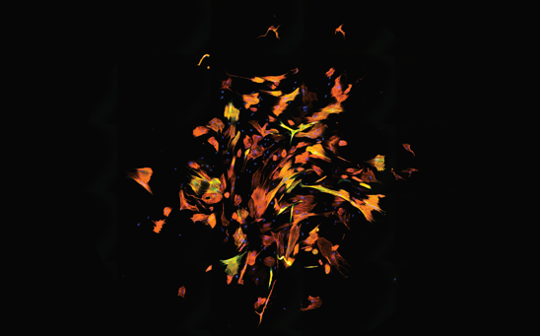
§ Rebuilding the Heart by Changing Cell Identity
The adult mammalian heart has a very limited capacity to replace cardiomyocytes lost after injury. Following myocardial infarction, damaged myocardium is largely replaced by scar tissue enriched in activated cardiac fibroblasts. Although scar formation helps stabilize the injured ventricular wall, the scar does not contract and can contribute to progressive cardiac dysfunction and heart failure.
Direct cardiac reprogramming seeks to convert activated cardiac fibroblasts directly into cardiomyocyte-like cells through the delivery of defined reprogramming factors.
Rather than producing cells outside the body and transplanting them into the heart, this approach aims to generate new cardiac muscle from cells that are already present at the site of injury.
Our research seeks to define the molecular principles that control cardiac cell identity and to develop more efficient, precise, and physiologically relevant strategies for direct cardiac reprogramming.
§ Why Direct Cardiac Reprogramming?
Current therapies for heart disease can reduce symptoms, slow disease progression, and improve survival, but they generally cannot replace the large numbers of cardiomyocytes lost after injury.
Direct cardiac reprogramming may offer several important advantages as a complementary regenerative strategy:
- It uses cells already present within the injured heart
- It skips the pluripotent state to achieve cell fate conversion
- It could simultaneously reduce scar-forming cells and generate new muscle-like cells
- It allows cell-fate conversion to occur within the native cardiac environment
The ultimate goal of direct cardiac reprogramming is not simply to activate a collection of cardiac genes. It is to generate cells that acquire the structural, metabolic, electrical, and contractile properties required to contribute meaningfully to heart repair.
To achieve this goal, our research program focuses on improving minimal reprogramming cocktails, engineering more effective reprogramming factors, and developing efficient in vivo delivery systems.
§ Improving a Minimal Cardiac Reprogramming Cocktail
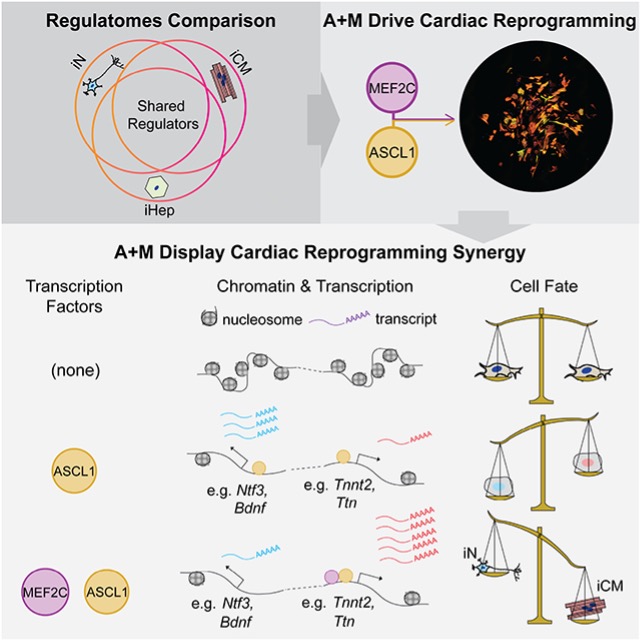
Our previous work identified a minimal combination of Ascl1 and Mef2c, referred to as A+M, that can initiate cardiac reprogramming.
The use of a minimal cocktail provides a simpler and more controllable platform for studying the mechanisms of cell-fate conversion. It may also facilitate the development of more practical delivery strategies. However, many A+M-treated cells remain incompletely reprogrammed and do not acquire the full molecular and functional properties of mature cardiomyocytes.
We therefore aim to improve the efficiency, quality, and long-term stability of A+M-mediated reprogramming.
Cell-fate conversion is not a simple on-off switch. Fibroblasts often pass through multiple intermediate states, and many cells fail to complete the transition toward a stable cardiac identity.
By defining these intermediate states, we aim to identify the molecular barriers that limit A+M reprogramming and the regulatory pathways that promote successful conversion.
These studies will help us determine how the timing, dosage, activity, and interactions of the A+M factors can be optimized to generate more fully reprogrammed and functionally mature cells.
§ Engineering Better Reprogramming Factors
Transcription factors can bind thousands of genomic regions and regulate multiple gene programs. Their effects depend not only on their ability to recognize DNA, but also on their interactions with cofactors, chromatin regulators, and other transcription factors.
A reprogramming factor may therefore activate both beneficial cardiac programs and unwanted non-cardiac or stress-associated pathways. Understanding how different protein domains control these activities may allow us to redesign reprogramming factors with greater specificity and potency.
We use protein engineering, domain-swapping approaches, functional screening, and genomic analysis to investigate how different regions of reprogramming factors contribute to cell-fate conversion.
This work allows us to ask:
- Which domains determine cardiac reprogramming activity?
- Which regions control DNA binding and genomic target selection?
- Can unwanted gene programs be reduced while preserving beneficial activity?
By understanding and redesigning the molecular components of reprogramming factors, we aim to move beyond empirical factor combinations toward more precise control of cardiac cell identity.
§ Developing Efficient In Vivo Delivery Strategies
Efficient and cell-type-specific delivery of reprogramming factors remains a major bottleneck for translating direct cardiac reprogramming into a therapeutic strategy.
An effective delivery system must reach fibroblasts within the injured heart, express the reprogramming factors at appropriate levels, minimize expression in non-target tissues, and support the controlled timing needed for cell-fate conversion.
In collaboration with investigators across CHOP and the University of Pennsylvania, we will explore engineered adeno-associated virus vectors and alternative delivery platforms for cardiac reprogramming.
Our studies will evaluate:
- AAV capsids with improved targeting of the injured heart
- Promoters and regulatory elements that restrict expression to target cell populations
- Strategies for controlling the timing, dosage, and duration of factor expression
We will compare candidate delivery systems using molecular, histological, and functional readouts to determine how effectively they induce cardiac conversion in vivo.
By integrating delivery engineering with mechanistic studies of cell-fate conversion, we aim to establish a practical framework for inducing cardiac reprogramming directly within damaged myocardium.
§ Long-Term Vision
Our long-term goal is to establish a mechanistic and engineering framework for converting resident cardiac fibroblasts into functional myocardium.
By understanding how cell identity is established, resisted, and rewritten, we hope to:
- Develop more efficient and reproducible cardiac reprogramming strategies
- Develop safe and efficient in vivo delivery systems
- Promote functional recovery of damaged myocardium
- Reveal general principles of cell-fate control that can be applied to other regenerative settings
Ultimately, direct cardiac reprogramming may provide a new strategy for repairing the injured heart from within.