Congenital Heart Disease Genetics
We connect human genetic findings to the molecular mechanisms and therapy of congenital heart disease.
§ Connecting Human Genetics to Cardiac Developmental Mechanisms
Congenital heart disease is genetically complex. Human sequencing studies have identified many candidate genes and variants, but the functional consequences of these discoveries often remain unclear.
A genetic association alone does not reveal which cardiac cell types are affected, when during development a defect first emerges, or how a variant disrupts the regulatory programs that guide heart formation. This gap between genetic discovery and biological mechanism limits our ability to interpret patient variants, develop accurate disease models, and identify opportunities for therapeutic intervention.
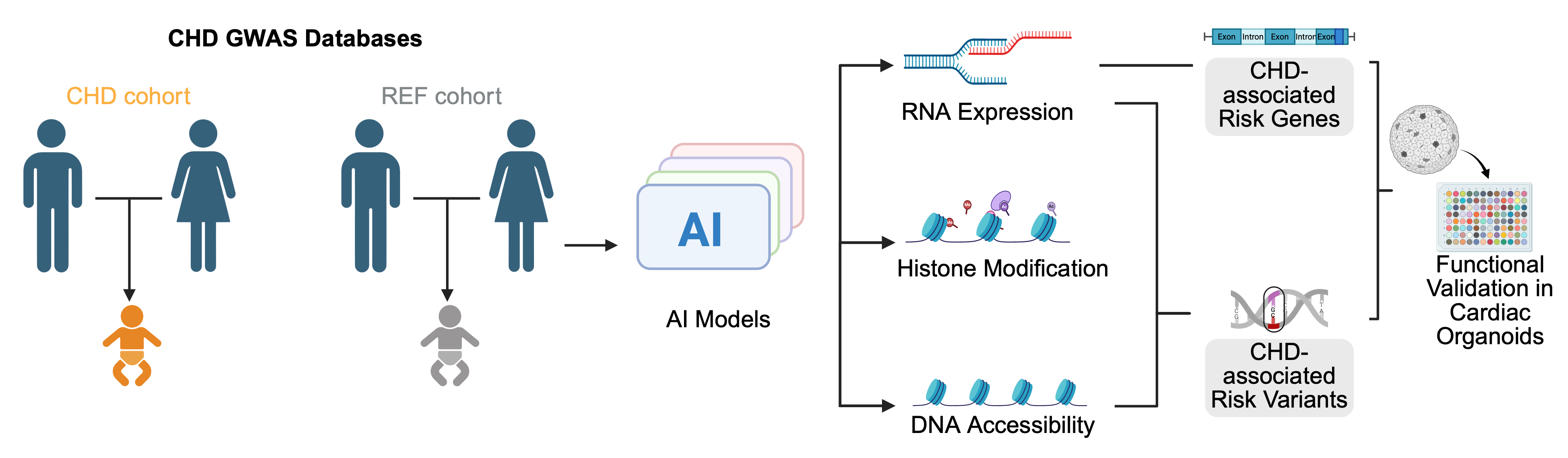
Working with clinical, genetic, and computational collaborators in CHOP, we aim to connect human genetic findings to the cellular and molecular mechanisms of cardiac development. We investigate how candidate genes and variants alter cell states, gene-regulatory networks and tissue-level development.
§ Prioritizing Disease-Associated Genes and Variants
We integrate evidence from AI, human genetics, developmental genomics, and cardiac single-cell datasets to identify candidate genes and variants for functional investigation.
Candidates are prioritized based on genetic evidence, developmental expression, cell-type specificity, predicted regulatory effects, pathway involvement, and conservation across experimental systems. This approach allows us to focus on genetic changes that are both clinically relevant and biologically positioned to influence heart development.
§ Testing Gene and Variant Function with CRISPR
We use CRISPR-based genome editing and gene-regulation technologies to determine how candidate genes contribute to cardiac development.
Depending on the biological question, we apply gene knockout, targeted introduction of patient-associated variants, CRISPR interference, CRISPR activation, and pooled perturbation strategies. These experiments allow us to move beyond genetic association and directly test whether a candidate gene or variant disrupts cardiac lineage specification, differentiation, proliferation, maturation, or tissue organization.
§ Modeling Human Heart Development with iPSCs and Cardiac Organoids
We use human iPSC-derived cardiomyocyte and cardiac organoids to model key stages of human heart development.
These platforms provide experimentally accessible systems for investigating human-specific developmental mechanisms and testing patient-associated variants in a controlled genetic background. Isogenic lines allow us to compare genetically matched cells that differ only at the candidate variant, helping us define its direct functional consequences.
Cardiac organoids further capture aspects of three-dimensional tissue organization, multicellular interaction, and developmental patterning that cannot be fully reproduced in conventional two-dimensional cultures.
§ Linking Molecular Defects to Cardiac Developmental Phenotypes
Our goal is not only to identify changes in gene expression, but also to determine how those changes affect cardiac development and function.
We therefore integrate molecular profiling with measurements of cell morphology, tissue architecture, contractile behavior and electrophysiology.
This combined approach enables us to trace the effects of a genetic alteration from disrupted molecular pathways to abnormal cell states and, ultimately, to tissue-level developmental phenotypes.
§ Long-Term Vision
Our long-term goal is to establish a functional framework for interpreting congenital heart disease genetics.
By connecting candidate genes and variants to specific cell types, developmental stages, regulatory programs, and tissue phenotypes, we aim to transform genetic discoveries into mechanistic knowledge.
This framework may help distinguish disease-causing variants from variants of uncertain significance for patient and eventually guide diagnosis and therapeutic discovery.